The question
Could climate stressors change how our brains age?
People of the same chronological age can have different cognitive, functional and brain profiles. Centred on Latin American cohorts, this workstream develops computational ageing models to investigate how heat, air pollution and wider social and environmental conditions relate to these differences.
Our approach
Measuring change across the brain
Build two ageing clocks
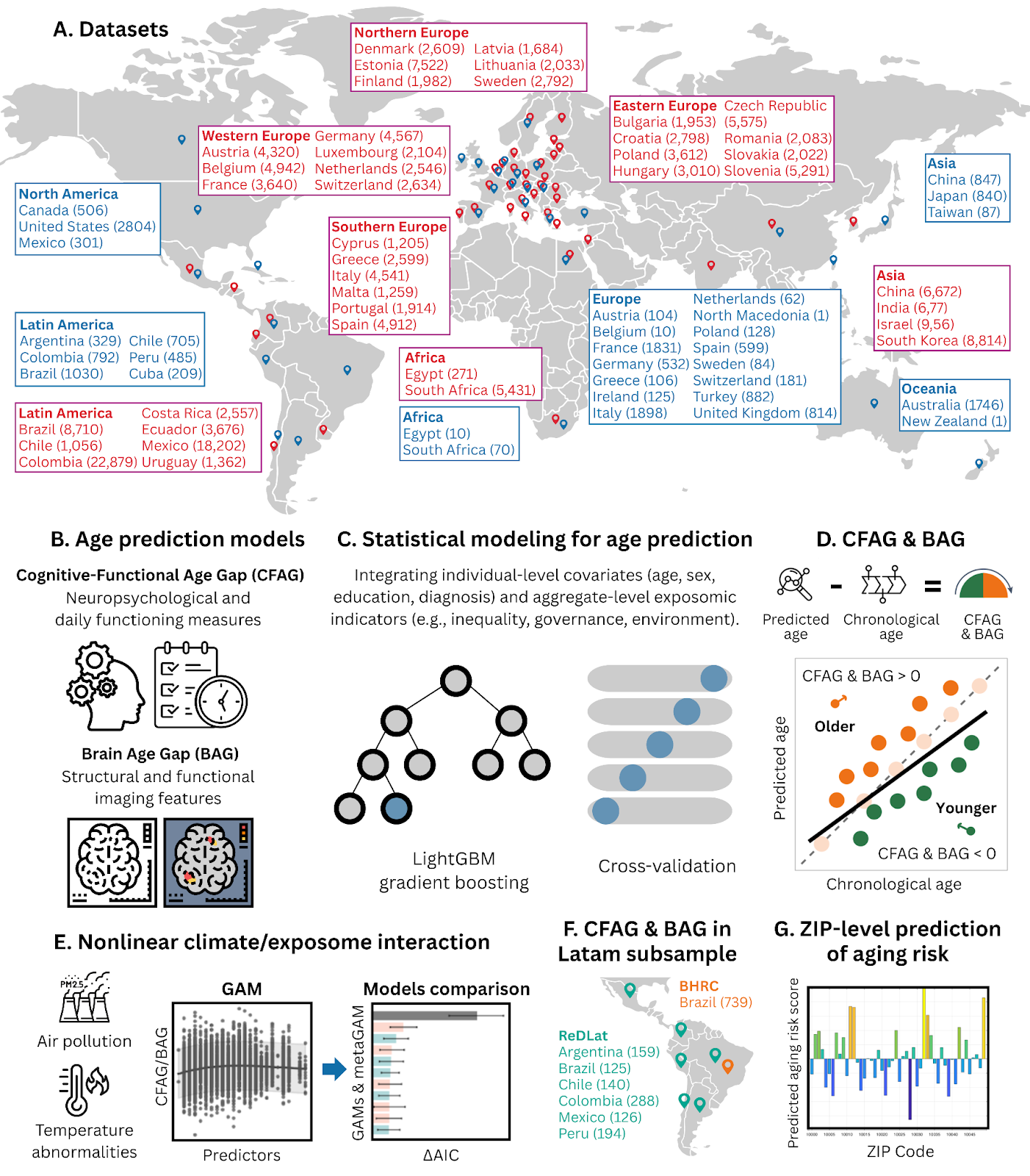
Develop cognitive-functional and brain-age models using international reference datasets, including cognitive assessments, daily functioning and structural and functional brain measures.
Study local exposure
Apply the models to geocoded ReDLat and Brazilian High Risk Cohort data. Compare residential heat and PM₂.₅ exposure with broader country-level environmental and social conditions.
Connect models with biology
Integrate Workstream 1 biomarkers with cognitive-functional and brain-age gaps to investigate pathways linking environmental exposures with neurological change.
What we aim to deliver
Planned outputs
- Cognitive-functional age-gap and brain-age-gap models
- Analyses of local and regional vulnerability
- Reproducible modelling tools and research publications
Workstream leadership
Dr Josefina Cruzat
Latin American Brain Health Institute (BrainLat), Universidad Adolfo Ibáñez
Dr Robbie Parks
Columbia University